Where to find people asking for what you sell. The early bird gets the ask

Alex · Founder of Magpie AI
Published · 7 min read
In short
Search the words people ask with, such as 'is there an app' or 'alternative to', plus your buyers' trade. Start on small forums, and answer in full before you name your product.
Contents
Somebody who types "is there an app that books grooming slots and texts the owner the day before?" has done half of your selling for you. They've named the problem, said they'd use software for it and asked strangers to point them somewhere. If you make that app, a good reply to that one post is worth more than a week of posting about your launch.
I've found a customer this way myself, from a reply to a post like that. It's where I'd start before any launch.
Search for the asking, not the topic#
Search for the words people use when they ask, plus a word from their trade. Searching your topic alone mostly turns up articles, adverts, rivals and people showing off.
There's an old study that shows how thin the topic route is. In 2013, three researchers at Graz took 1,335 tweets that held shopping words like "buy", "price", "deal" and "sale", and read every one. Only 120 showed any intent to buy or sell, and 70 an intent to buy. Half of their 16 keywords never caught a single one. That's Twitter thirteen years ago, and a small hand-read set, so I wouldn't lean on the exact share. The lesson holds, though: a shopping word isn't a shopper.
The phrases that catch people asking are plain ones:
- "is there an app" or "is there a tool" that does the job
- "alternative to" and the name of the tool they're leaving
- "what do you use for" and the task
- "anyone recommend" or "looking for something that"
Pair each with a word your buyers would use and you won't. A made-up booking app for dog groomers, trimbook.example, shows the difference.
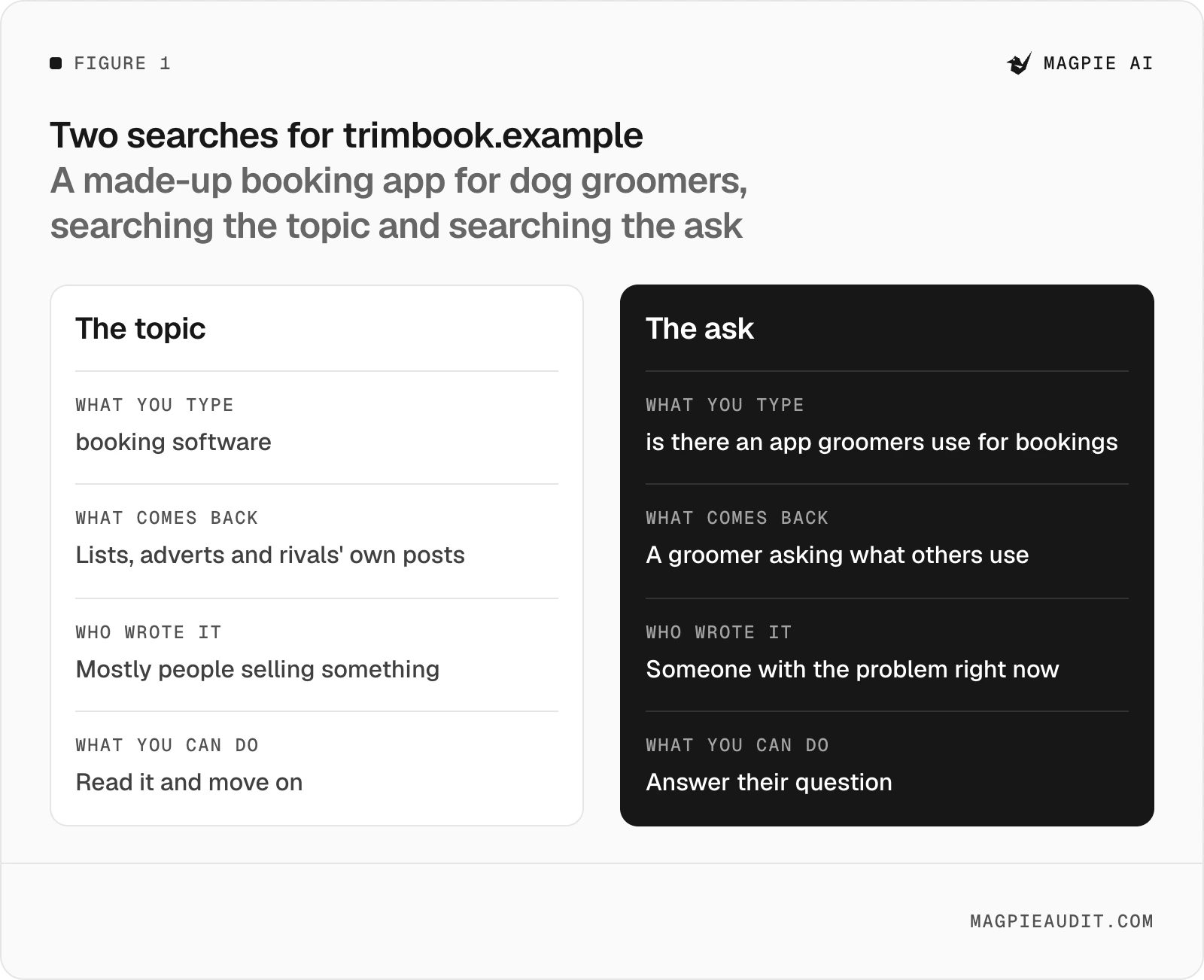
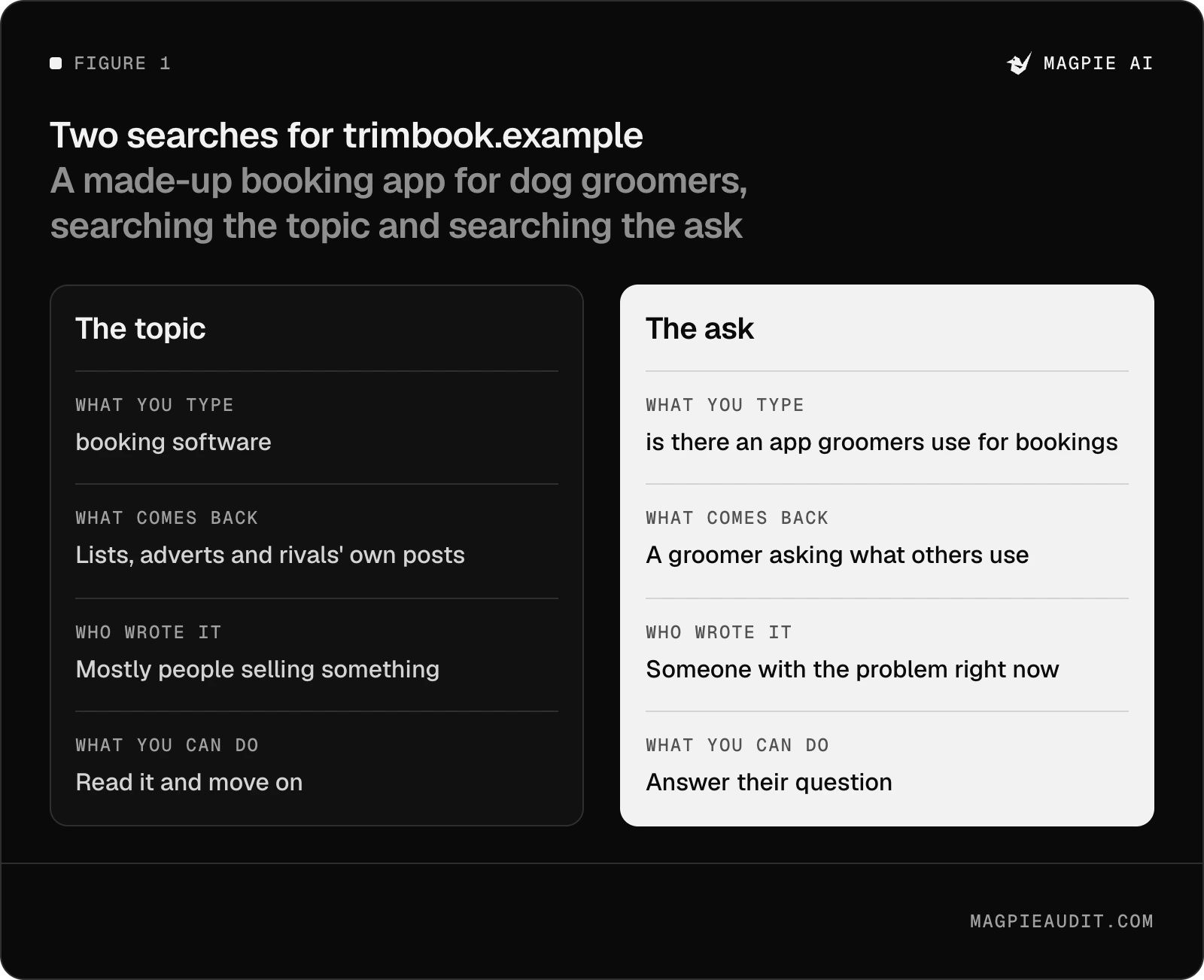
The "alternative to" searches are the warmest of the lot. Someone leaving a tool has already decided to pay for one, and often says exactly what annoyed them, which is worth writing down whether or not you reply.
Small forums, where your buyers already talk#
Small forums for one trade or one kind of user are the place I'd start, and I think they're the most overlooked. There are fewer posts than on the big networks, but nearly all of them come from the people you sell to. Birds of a feather, and all that.
I counted the 30 newest topics on MPU Talk, the forum of the Mac Power Users podcast, on 28 November 2026. Five of them asked for an app or an alternative to one in the title alone: a scanning app for the iPhone, games without heavy in-app purchases, open source alternatives to an email marketing service, and two more. One was a maker posting their own new app. That's one ask in six, from people who already know what they want from software.
To find yours, search for your buyers' trade plus "forum" or "community". A lot of these run on Discourse, and Discourse's own forum puts the etiquette well: "Please spend some time browsing the topics here before replying or starting your own." Read a week of threads before you post anything. You'll learn the questions that come up every month, and the regulars will have seen your name on helpful replies before they ever see your product.
Many forums keep selling to one category. Discourse's own says "Soliciting for work should only occur in the public Marketplace category", and smaller forums often have a rule like it pinned at the top.
Stack Exchange's Software Recommendations#
Every question on Software Recommendations asks for software. Its help page says the site is for "What software can I use to do [...]?" questions, and wants each to state a purpose and "some objective requirements", so you get a list of exactly what the person needs before you write a word.
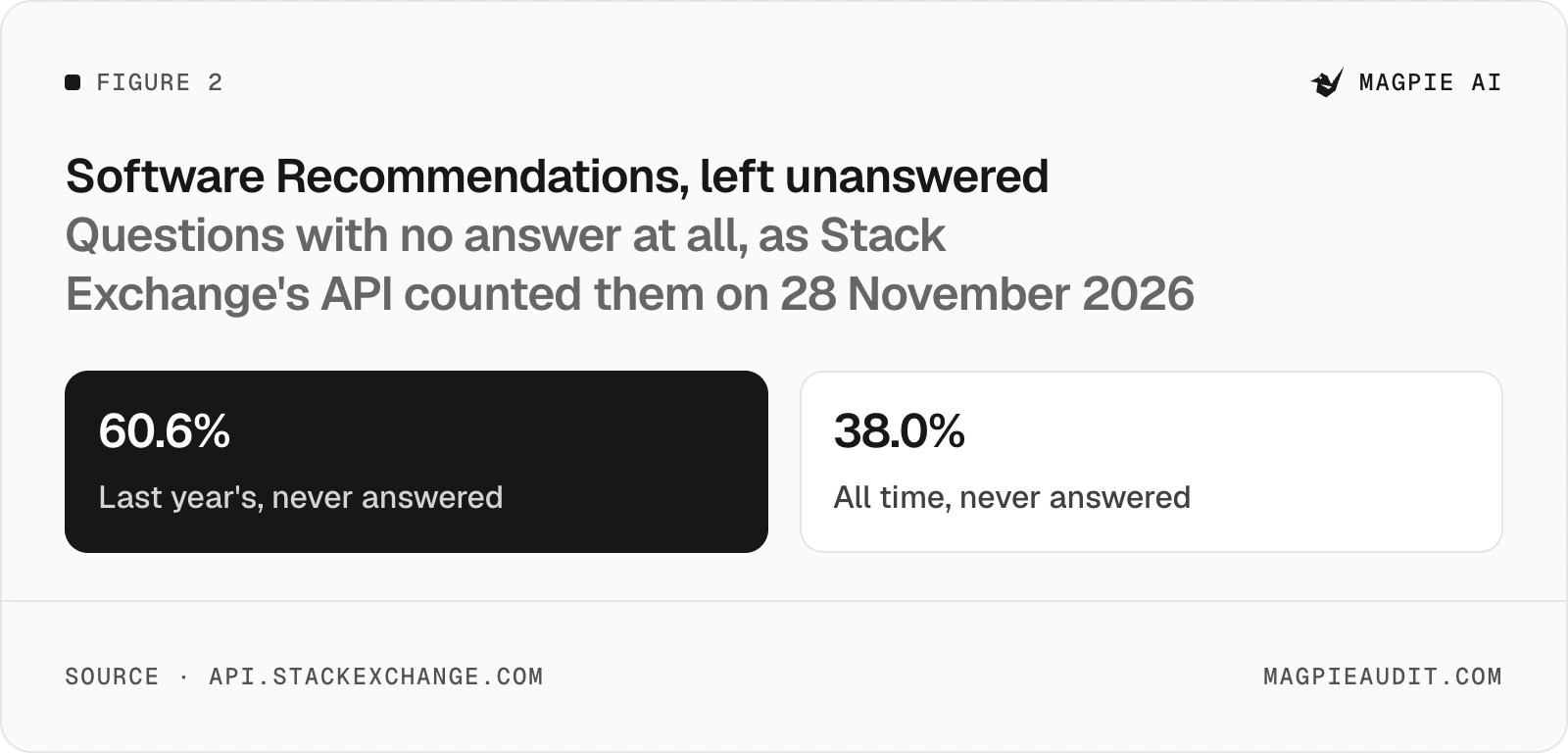
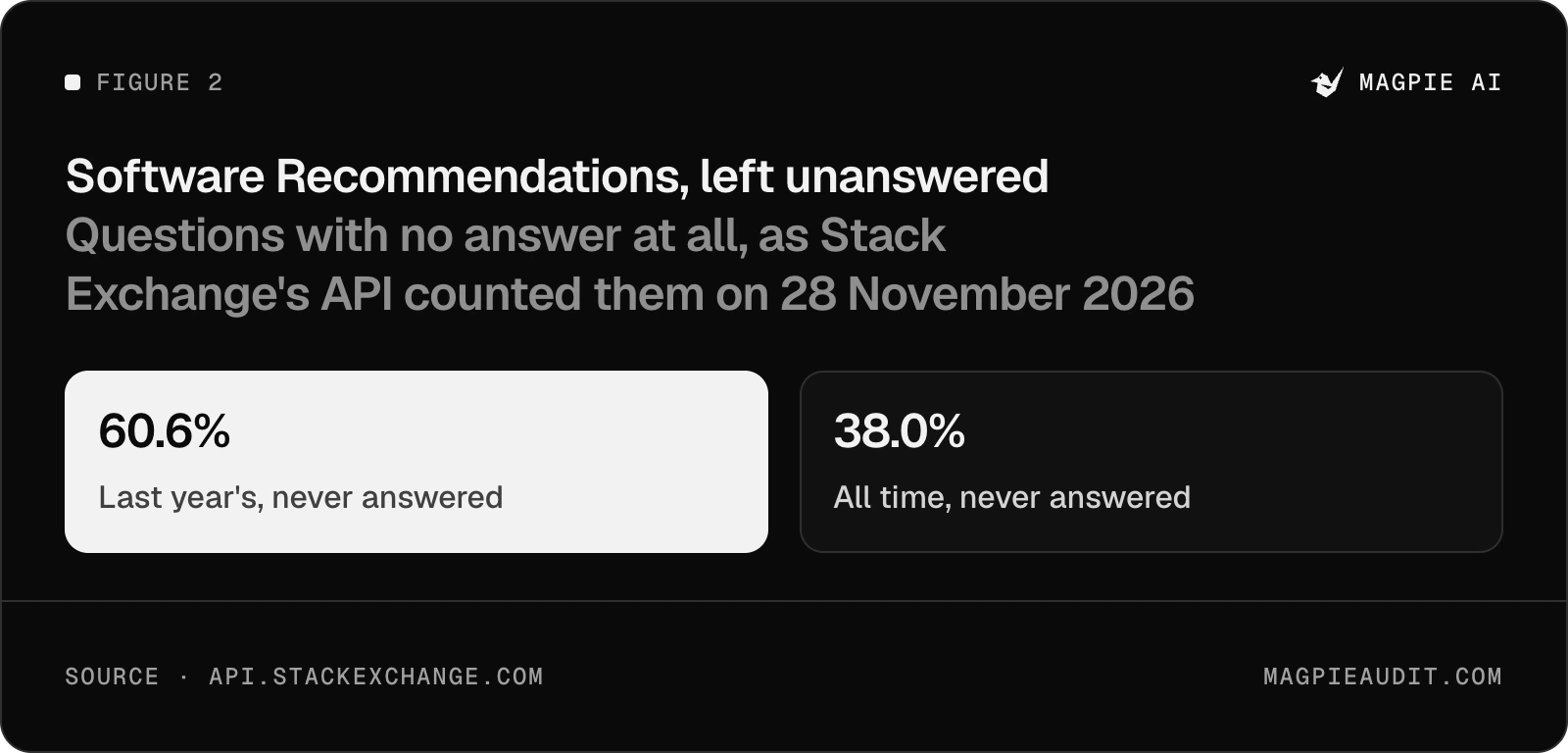
Most of them never get an answer. I asked Stack Exchange's public API on 28 November 2026. Of the 231 questions asked in the year to 1 November 2026, 140 have no answer at all.
The rules there are strict and clear. Answers should "demonstrate how the recommended product meets the requirement", so you go through their list point by point. And the network's page on promotion says that if you mention your product, "you must disclose your affiliation in your post." A line like "I make this, so I'm biased" covers it.
The same page has my favourite rule on the subject: "Always solve the asker's problem." If your product only covers half their list, say which half, or answer with something else.
Bluesky and Hacker News#
Both are worth a search, with their own rules in mind. Bluesky's search finds plain asks ("does anyone know an app that…") and its guidelines are short on this: "Do not post undisclosed commercial content, sponsored material, or advertising without clearly identifying its commercial nature to other users." Say it's yours and you're within them.
Hacker News is pickier. Its guidelines say "Please don't use HN primarily for promotion. It's ok to post your own stuff part of the time, but the primary use of the site should be for curiosity." Ask HN threads where someone asks what people use for a job are fair game for a real answer. A reply that reads like a pitch won't last long there, and the guidelines also say "Don't post generated text or AI-edited text", which I'd take as a rule for every place on this page.
Reddit has plenty of these posts, and plenty of rules. I wrote a whole article on promoting on Reddit without getting banned, so I'll only say here that you read each community's rules before you reply.
Reply with help, then say it's yours#
Pitching instead of helping is the mistake I see most. A reply that opens with the product's name and a link reads as an ad to everyone, the person who asked included, and on most of these places it's removed or ignored.
Answer the question as if you had nothing to sell. Then, if your product really fits, name it once and say in the same sentence that you make it. That's good manners, and in the US and the UK it's also what the rules on endorsements ask of you (the Reddit article has the detail). Keep the useful part public, so the next person with the same question finds it in a year.
If you've answered well, people click your name. That's where your link can sit, and it's why the page it lands on matters. Someone who asked about grooming bookings should see bookings for groomers in your first screen, not a line about growing a business.
A routine you can keep#
Twenty minutes, twice a week, beats an afternoon once a month. I'd rather reply while the person is still choosing, since a late answer is mostly read by whoever searches next.
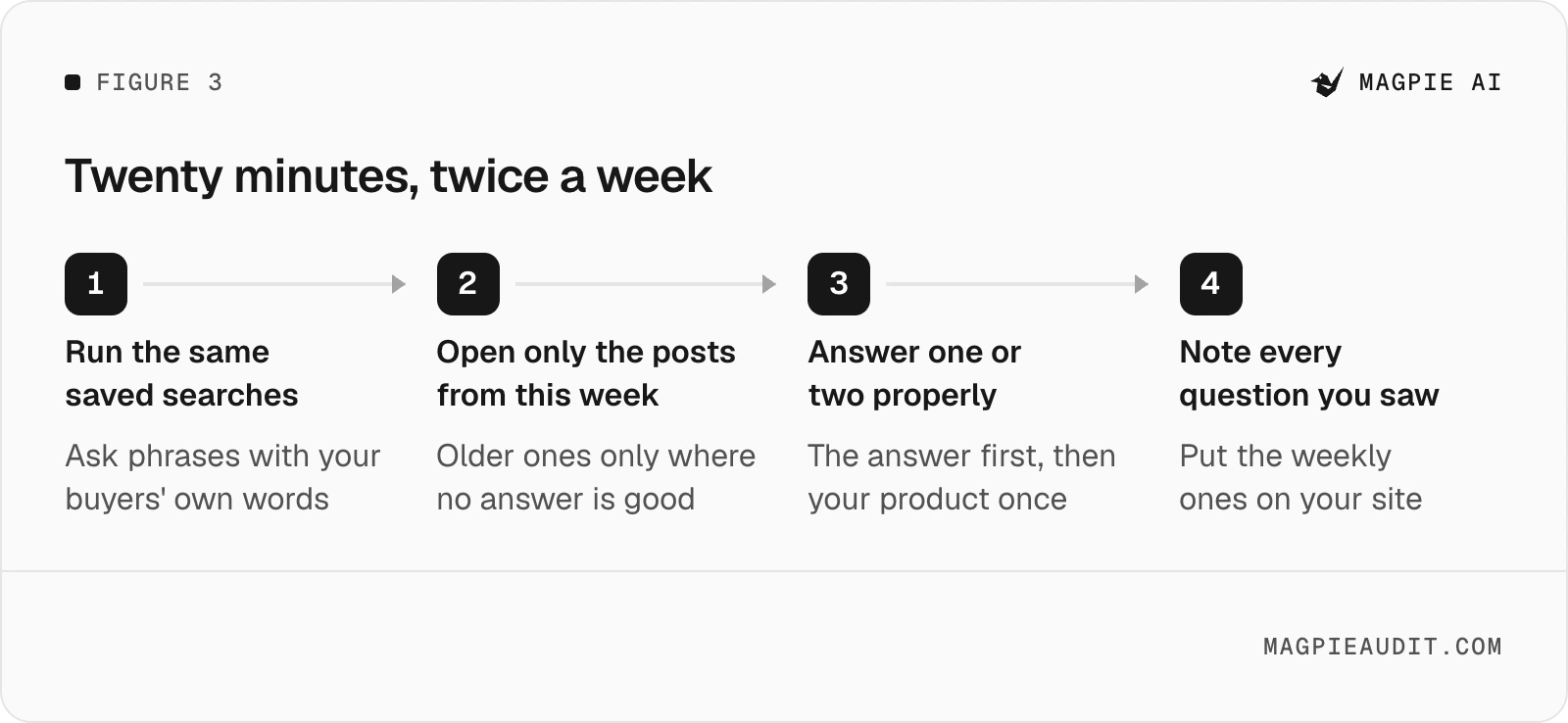
That last step is the one people skip. The questions strangers ask about your kind of product are the same ones your visitors have and don't ask, so they're the questions your landing page should answer. If you'd rather not do the searching at all, Magpie's Leads tab finds these posts for a site on Plus or Pro and lists the hottest first. You still write the replies.
Questions people ask#
Should I message people who asked, instead of replying?#
Only if they ask you to. A private message from a stranger with a product reads as spam on nearly every platform, and a public reply helps the next person too.
Can I use a tool to post replies for me?#
No. Hacker News asks you not to "automate posting", Bluesky counts repeated posting that disrupts conversations as spam, and the replies would read like it anyway. Finding the posts with a tool is fine. Writing the replies is the bit that has to be you.
Is it worth answering an old thread?#
Sometimes. On Stack Exchange, yes, since the help page asks you to "answer for the ages" and those pages keep getting found in search. On a forum, reviving a thread from two years ago to mention your product looks exactly like what it is, so I'd only do it where the thread is still the top search result for the problem and nobody has given a good answer.
8 sources
- Hollerit, Kröll and Strohmaier, Towards Linking Buyers and Sellers: Detecting Commercial Intent on Twitter (WWW 2013) (opens in a new tab)
- Stack Exchange API, Questions with no answers (opens in a new tab)
- Software Recommendations Stack Exchange, What topics can I ask about here? (opens in a new tab)
- Software Recommendations Stack Exchange, How to not be a spammer (opens in a new tab)
- Hacker News Guidelines (opens in a new tab)
- Bluesky, Community Guidelines (updated 19 September 2025) (opens in a new tab)
- Discourse Meta, Guidelines (opens in a new tab)
- MPU Talk, the Mac Power Users forum (opens in a new tab)
About the author
Alex · Founder of Magpie AI
Alex founded Magpie AI and writes about turning a site's visitors into customers